



A payment processing portfolio is a collection of business accounts. Each of these accounts is a company that utilizes merchant services to receive customer debit or credit card payments. Every time a company’s customers complete purchases, sales agents and Independent Sales Organizations (ISOs) earn a small profit. That makes amassing a portfolio an attractive way to earn residual income from merchant transactions.
An essential aspect of success in this industry is recognizing and boosting the profit potential of payment processing portfolios.
In this post, you’ll learn:
- The factors determining a portfolio’s profit potential
- How merchant service portfolio trends in 2025 can impact profits
- How to optimize your payment processing portfolio for maximum returns
Understanding how to maximize portfolio earnings requires a deep dive into the previously mentioned areas. However, these proactive steps can help ensure sales agents and ISO enjoy stability and increased profits.
What Factors Determine the Profit Potential of Payment Processing Portfolios?
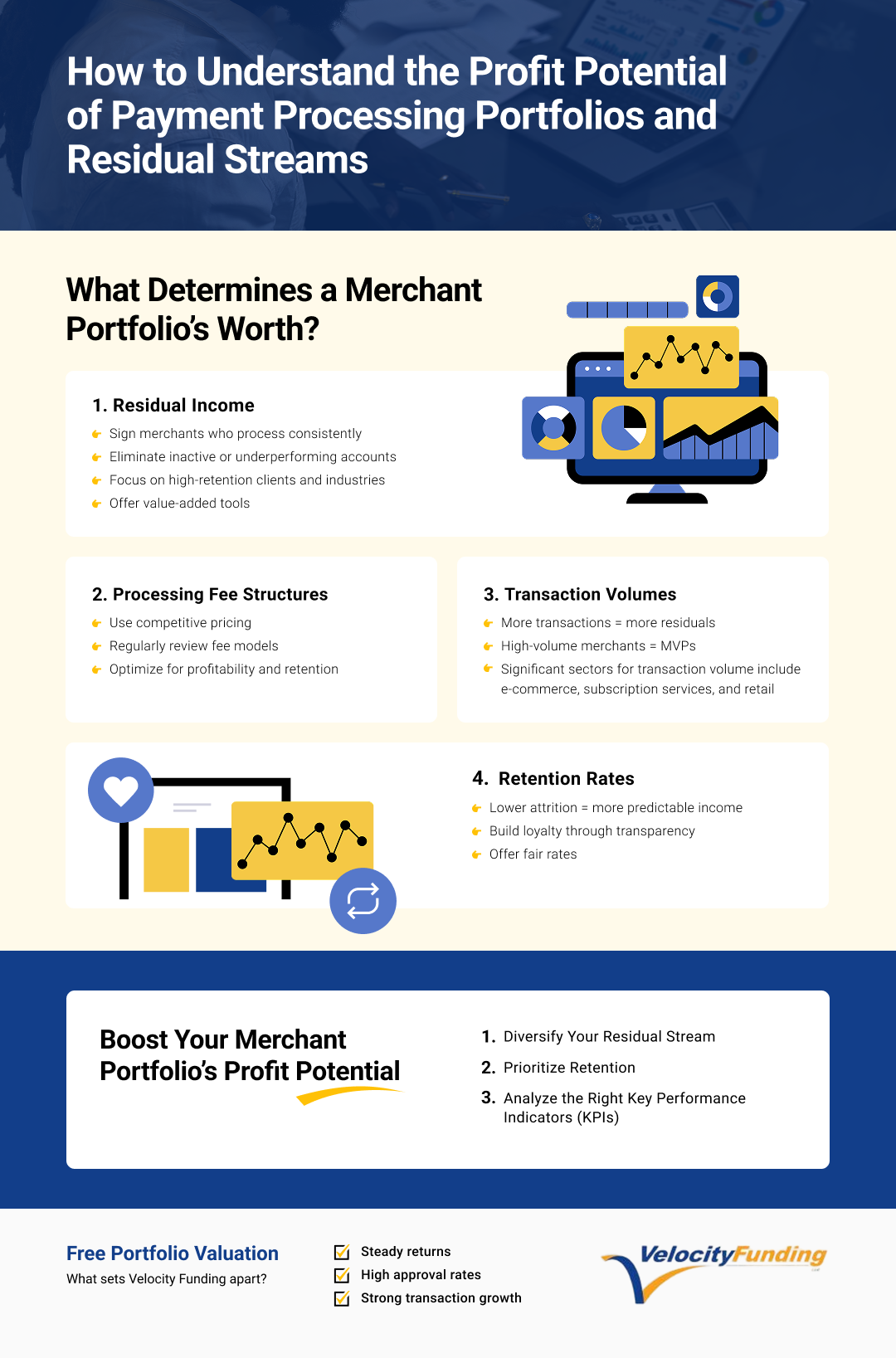
Several factors are vital in a portfolio’s ability to earn consistent income. These factors include portfolio transaction volumes, processing fee structures, and customer retention.
Portfolio Transaction Volumes
When discussing payment processing portfolio profit potential, there’s almost no more crucial factor than their transaction volumes. This information concerns the number of transactions that occur and their respective volumes.
If one portfolio reports 15,000 monthly transactions, it’s likely to earn more significant residuals than a portfolio reporting 100 monthly transactions. This factor may seem out of your control as an ISO or sales agent. However, there are a few proven ways to ramp up portfolio transaction volumes, including:
- Enticing clients to accept more payment solutions, such as AMEX or Discover.
- Targeting merchants and/or industries known for high-volume sales
Many ISOs and agents focus on working with companies that utilize e-commerce platforms and subscription-based products or services. This strategy increases the profit potential of payment processing portfolios because these businesses generate predictable and regular revenue.
Processing Fee Structures
Payment processors utilize different pricing models. Choosing the right one can help ensure a high-profit potential for payment processing portfolios. The model to choose depends on many factors, such as card types, transaction volumes, and the industry or category in which a company operates.
Changing your structures could be wise if you’re not earning enough residual income from merchant transactions. Most portfolios have non-performing or negative residual accounts. Turning these negative accounts into actively processing accounts is a great way to increase profitability.
Residual Income
A reward for the time and effort spent building your portfolio comes in the form of residual income. Instead of lump-sum payments, agents and ISOs depend on consistent revenue from their merchants.
As with processing fees and transaction volumes, portfolio management strategies exist to help boost your residual income. These methods include:
- Looking over and updating pricing structures to stay competitive
- Investing in exceptional customer support to reduce attrition
- Focusing on attracting and retaining high-volume merchants
Building strong merchant relationships and providing value-added services, such as POS systems, Gift Cards, chargeback protection and fraud prevention tools, can boost your portfolio’s long-term residual income.
How Merchant Service Portfolio Trends in 2025 Can Affect Your Profits

The payment processing world is constantly evolving. However, staying on top of 2025 merchant service portfolio trends can help you gain an advantage over your competitors.
A Continued Move Toward Digital Payments
There’s no denying that digital payment solutions are being widely adopted. If a business isn’t adopting these cutting-edge ways to pay, it could miss out on maximizing the profit potential of its payment processing portfolio.
Sometimes, merchants don’t adopt these new solutions because they are unaware of them, because of this, agents and ISOs have an opportunity to educate merchants about contactless and mobile payment solutions.
Increased Regulatory Scrutiny
The government’s financial regulators issue and change compliance requirements that ISOs and agents must adhere to. These regulations can affect 2025 merchant service portfolio trends due to transaction security and data privacy changes. Future government regulations are also likely to implement new methods to curb fraud.
You can’t predict what regulations will occur in the future. However, you can react quickly to regulatory changes that affect your processing fee structures and other aspects of your business. Making fast adjustments protects the profit potential of payment processing portfolios by ensuring you stay PCI compliant and avoid other regulatory fines.
A Need for More Transparency
Transparency remains essential for any business venture and will be a significant trend in the merchant services portfolio in 2025. With a world of readily available digital information, customers want and value clarity from agents and ISOs. You can cater to these clients by ensuring you utilize transparent fee structures. This strategy is also achievable by offering businesses customized merchant services solutions.
Optimizing Your Portfolio for Maximum Residual Income From Merchant Transactions
It may seem impossible to fully unlock the profit potential of payment processing portfolios. But it’s not. Instead of guessing what works, utilize a different approach. Check out these proven portfolio management strategies to optimize your accounts for maximum income.
Diversification for Proper Portfolio Management
As many investors and business leaders know, diversification is crucial to successful investing. One way to achieve this goal is to have a mixed merchant portfolio. This strategy involves managing accounts that span different industries and business types. Portfolio diversification can reduce risk by avoiding a single sector’s downturn.
Increase the profit potential of your payment processing portfolio through diversification by:
- Researching and entering into emerging industries
- Acquiring more low-risk but stable merchants
- Balancing riskier clients with steady and long-term businesses
Maximizing Customer Retention
Even ISOs and agents with perfectly mixed merchant portfolios must focus on retaining customers. Skyrocketing merchant attrition rates can wreak havoc on what was once predictable residual income. Implementing strong retention strategies can keep companies loyal.
Key customer retention methods include:
- Responding fast to concerns and questions
- Checking in with merchants often
- Focusing on exceptional customer service
- Incentivizing loyal merchants with lower fees or enhanced services
- Make sure your Merchants have up to date terminals and POS equipment
Digging Deeper Into Portfolio Analytics

Harnessing the power of data analytics is another way to generate untapped insights into the profit potential of a payment processing portfolio. Portfolio analytics can involve tracking patterns, assessing potential future risks, and identifying areas of opportunity for growth.
Crucial key performance indicators (KPIs) of portfolios include:
- Customer Lifetime Value (CLV): Looking at this vital metric can help ensure you’re not prioritizing short-term gains over more profitable long-term client relationships.
- Attrition Rates: Almost nothing can jeopardize your residual income more than increasing customer turnover. If this happens, finding out why businesses are leaving can minimize attrition’s impact on your bottom line.
- Transaction Volume Trends: Examining your portfolio’s overall transaction volume can help you determine whether your merchants are doing well or experiencing sales slumps. Spotting problems early can help you generate merchant-related solutions to prevent these issues.
Maximizing the profit potential of payment processing portfolios can boost agents’ and ISOs’ success. Creating a mixed merchant portfolio, monitoring key analytics, and improving customer retention are ways to proactively increase the collective value of your managed accounts. For more help, schedule a complimentary portfolio valuation from Velocity Funding.