




Key Takeaways:
- Buyers want predictable revenue, stable merchants, and clean documentation.
- Preparation matters as much as the portfolio itself.
- The more you diversify your portfolio and highlight unique features, the higher your valuation potential.
- Understanding what buyers look for in a merchant services portfolio is the fastest way to position yourself for stronger offers.
Selling a merchant services portfolio isn’t hard. Selling it for what it should be worth? That’s the puzzle. A significant aspect of getting that question right is knowing what buyers want.
And here’s the funny thing: Most agents think buyers care about one thing. Residuals.
But anyone who truly understands what buyers look for in a merchant services portfolio knows buyers evaluate the entire ecosystem: performance, cleanliness, concentration, tech stack, merchant mix, risk exposure, and even the personality of the seller. Yes, really. Buyers like predictable people almost as much as predictable income.
So, let’s break this down clearly. Because when you understand how to prepare your merchant service portfolio, everything becomes easier: the outreach, the negotiations, the valuation, and the exit.
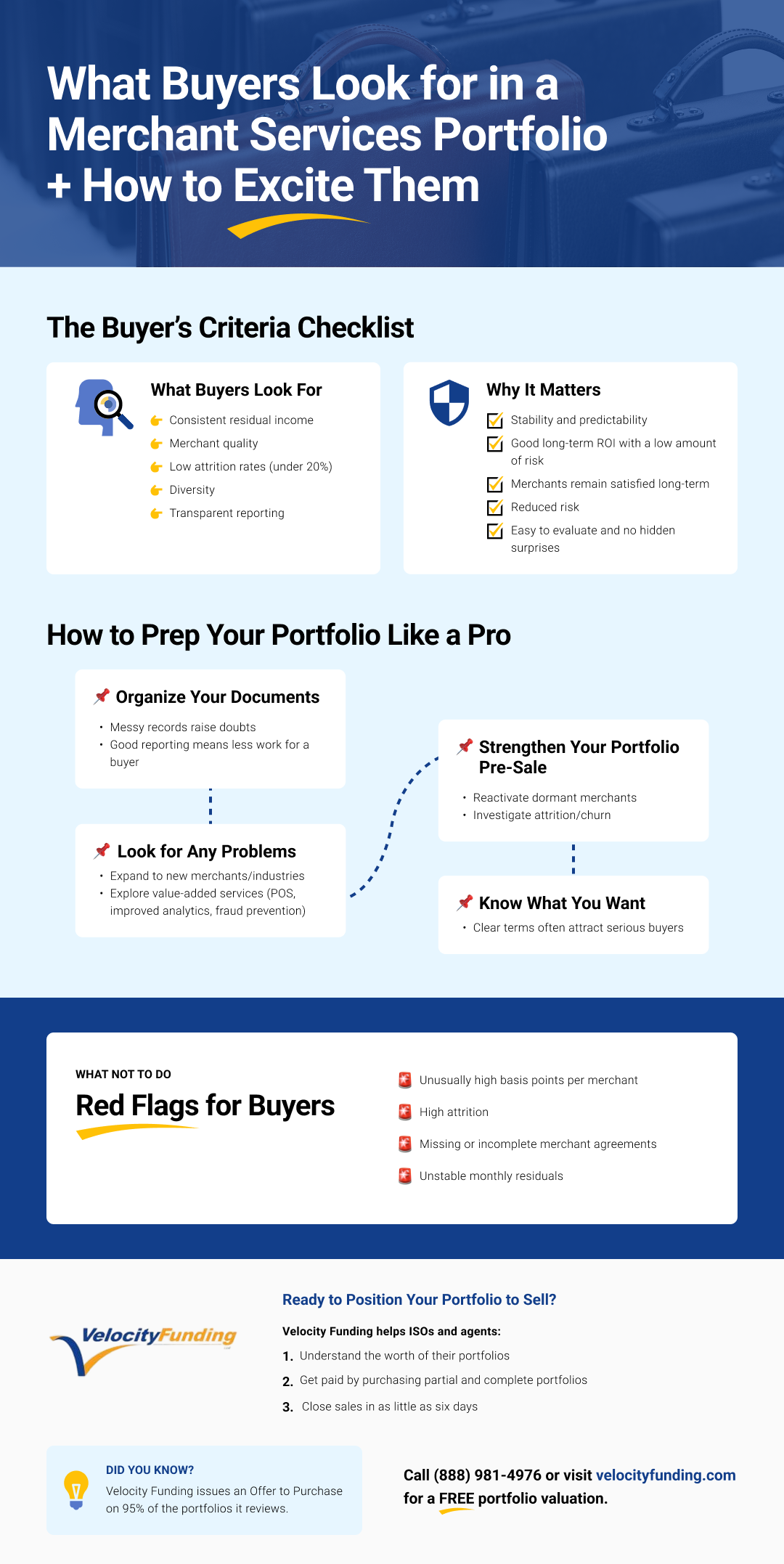
The Real Criteria: What Buyers Actually Care About
Here’s the truth that people don’t always say out loud:
Buyers don’t need a perfect portfolio. They need a predictable one.
And that’s the core of what buyers look for in a merchant services portfolio: stability.
Yes, MRR matters. Yes, issues of attrition. But those aren’t the only signals buyers study. They look at patterns, behavior, merchant types, reporting consistency, and whether the seller actually knows their own book.
Let’s walk through the significant factors, the ones that decide whether a buyer leans in… or quietly steps away.
1. Predictable Revenue Patterns (Not Spikes and Crashes)
Buyers don’t like roller coasters. They want smooth lines, steady growth, or at least stable plateaus.
If your residuals look like heart monitor spikes, it doesn’t matter how high the peaks are. Uncertainty kills multiples. That’s why understanding what buyers look for in a merchant services portfolio begins with proving that your monthly revenue behaves consistently.
You’d be surprised how many agents think volatility “shows potential.”
Buyers see risk. And risk lowers offers.
2. Merchant Longevity (Buyers Love Long-Term Relationships)

Merchants that stick around for years?
Buyers practically drool.
Long tenure signals trust, service quality, and low churn likelihood, three things at the top of the list of what buyers look for in a merchant services portfolio.
Even if volume isn’t massive, a 4-year merchant is worth more than a brand-new high-spender.
Buyers know the new guys might bail. Old ones? They’re sticky.
3. Portfolio Concentration (One Big Merchant = Not Good)
Every buyer checks for concentration.
If one merchant makes up 20%, 30%, or god forbid 50% of your revenue… that can be a problem.
It’s one of the first signs buyers study when determining what buyers look for in a merchant services portfolio because concentration turns a stable book into a gamble.
You want balance, spread, and consistency.
That’s why advisors always say it’s smart to diversify your portfolio and highlight unique features when you can. The more evenly distributed your revenue is, the safer it appears and the higher the multiple.
4. Clean, Organized Documentation (The Underrated Power Move)
You know what scares buyers more than low numbers?
Messy paperwork. Missing contracts. Chaotic spreadsheets.
If a buyer can’t evaluate your book in one sitting, they assume the worst. It’s that simple.
And because documentation is such a core part of what buyers look for in a merchant services portfolio, having clean, sorted files instantly increases confidence.
Clarity = higher offers.
Confusion = discounted ones.
5. Merchant Mix and Risk Exposure
A portfolio full of vape shops, adult entertainment, or high-risk processors?
Buyers notice fast.
Risk-adjusted valuations are normal. However, high-risk merchants can drag your numbers even if the residuals look good on paper.
But this is important when learning what buyers look for in a merchant services portfolio: high-risk accounts aren’t dealbreakers if you provide context. Documentation, explanations, and contract stability? They all matter.
This is also where diversifying your portfolio, even gradually, helps prevent any single risk category from dominating the book. When you pair that with the ability to highlight unique features that make your merchants stickier, buyers see strength, not fragility.
6. Technology Adoption (The Stickier the Better)
If merchants rely on tech you installed, they’re much harder to steal away. Old technology will require upgrades in equipment which traditionally increases costs and attrition.
Up to date Tech-enabled merchants are a significant positive signal in what buyers look for in a merchant services portfolio, because tech = stability.
Better yet, if you diversify your portfolio across industries and tech setups, buyers will see long-term income, not short-term wins.
Get a FREE Merchant Services Portfolio Valuation
How to Prepare Your Merchant Service Portfolio

Now, we shift from what buyers want to how to prep a portfolio that actually reflects that value.
Because valuations are not just math.
They’re presentations, clarity, and story.
Let’s go step-by-step.
Step 1: Clean Up Your Residual Reports
Buyers don’t want to play detective.
They want precise numbers that make sense.
So, before you present anything, organize:
- 12-24 months of residuals
- Correct merchant IDs
- Notes on cancellations
- Explanations for dips
- Contract terms
- Processor transitions
Most agents never truly learn how to prepare a merchant service portfolio. They just “hope the buyer figures it out.” Buyers hate that.
Understanding what buyers look for in a merchant service portfolio starts with getting your numbers under control. Clean reports signal consistency, and consistency is what buyers trust.
Step 2: Document Merchant Behavior Like a Pro
Who left? Who stayed? Why?
Buyers don’t just review totals. They review patterns.
Document:
- Average merchant tenure
- Churn reasons
- Industry types
- Monthly volume patterns
- Chargeback histories
When you explain behavior, buyers see stability.
Once you understand merchant behavior, you’re already halfway toward learning how to prepare your merchant service portfolio in a way that attracts better offers. Buyers want to see patterns they can rely on.
Step 3: Address Weaknesses Before Anyone Else
This is the part sellers avoid… but shouldn’t.
Fix what you can.
Explain what you can’t.
Maybe you can’t diversify your portfolio fast enough, a merchant went bankrupt, or a processor glitch caused a volume dip.
Buyers don’t need perfection – just honesty.
And when you identify weak points yourself, you instantly demonstrate that you know what you’re doing. Addressing weaknesses is also the perfect moment to highlight unique features that make your portfolio stand out. Maybe it’s an unusually long merchant tenure, a niche vertical you dominate, or tech integrations that create stickiness.
Step 4: Diversify Your Portfolio
Buyers pay more for uniqueness. They pay more for stability.
And they pay more for anything that feels hard to replace.
So as you complete this step, highlight unique features and lean into specifics:
- Unusually high average tenure
- Niche industries with low churn
- Integrated tech stacks
- Strong regional dominance
- Exceptional retention history
These details do more for valuation than most agents realize.
And they’re directly tied to what buyers look for in a merchant services portfolio because buyers want competitive advantages, not just revenue.
When you take the time to show buyers what makes your book different, what do you do? It changes how they evaluate everything else. People remember the details. Unfortunately, most sellers never bother. But the ones who do? They stand out immediately.
Step 5: Present Yourself as the Calm, Organized Seller
Here’s the secret no one mentions:
Buyers value sellers almost as much as the portfolios.
Calm, responsive, clear communicators get better offers. Unprepared, emotional, or unorganized sellers receive a discount.
Learning how to prepare your merchant service portfolio also means preparing yourself to communicate how you respond to questions. Buyers notice everything.
Final Thoughts
If you strip away all the spreadsheets, metrics, reports, and industry jargon, it all comes down to this:
Buyers want confidence.
They want to understand what they’re buying, why it’s stable, and how predictable the future income will be. That’s the real foundation of what buyers look for in a merchant services portfolio, and it’s the same foundation you should use when preparing your book for sale.
When you know how to prepare your merchant service portfolio, you stop hoping for reasonable offers and start earning them.
Get a FREE Merchant Services Portfolio Valuation

Dean Caso is a Managing Partner at Velocity Funding, which he founded with this company’s other Managing Partner, David Caso, in 2006. Caso graduated in 1983 from Babson College with a Bachelor’s degree in Finance and Investments. With over 35 years of experience, Caso has acquired over 300 credit card processing portfolios. He has a superior eye for opportunity and an unwavering commitment to excellence. Caso’s leadership instills confidence, fosters innovation, and inspires those under his professional command. His decades of industry experience and proven track record of success continue to drive Velocity Funding’s growth and industry-leading presence.